
Most organizations don’t fail because they miss the future. They fail because they cannot let go of the past. For law firms, the question is no longer whether change is coming; it is whether their current structures can keep pace with it.
History is filled with companies that saw major changes coming, invested in the right innovations, and even helped create the future they would eventually lose to competitors. Their downfall wasn’t a lack of vision. It was an inability to reshape the corporate structures, processes, and assumptions that had made them successful in the first place.
Eastman Kodak is an instructive example. 50 years ago, a Kodak employee built the first handheld digital camera. Kodak actively participated in the development of the new device. The company supervised the project and filed patents. The invention placed Kodak in an extremely strong competitive position for the future digital camera market, yet somehow Kodak never became a leader in that market.
Kodak didn’t miss the digital age because it lacked access to the technology or misunderstood its potential impact; what it could not do, at least not quickly enough, was move beyond a business model built on film sales and processing fees, and the habits and structures that had served it well for decades.
Why does the Kodak story matter? The danger is rarely that leaders cannot see change coming. More often, the problem is that the organization is too deeply organized around a model that has made it successful in the past.
Law firms should pay attention. Different questions are being asked about marketing and business development than even three years ago.
Not simply:
- How many pitches did we produce?
- How quickly can we turn this around?
- Who is updating the directory submission?
But instead:
- Are we organized to compete?
- Do we know where our best opportunities are?
- Can our current structure support client expectations?
- What happens when AI handles the tactical work that has long consumed MBD capacity?
Those are different questions because the market has changed. Clients are more sophisticated. Competition is more intense. Procurement has more influence. Lateral movement is constant. Cross-practice collaboration is no longer optional. Client experience matters more. Data is central to decision-making. And AI is accelerating operational change at a pace the legal industry has not seen before.
Cracks in the Existing Model
For years, law firm marketing and business development teams were designed for responsiveness. Lawyers needed help moving work out the door, and MBD departments became proficient at supporting pitches, events, submissions, content, credentials, and other partner requests. That model worked when the market was less complex and expectations were easier to manage.
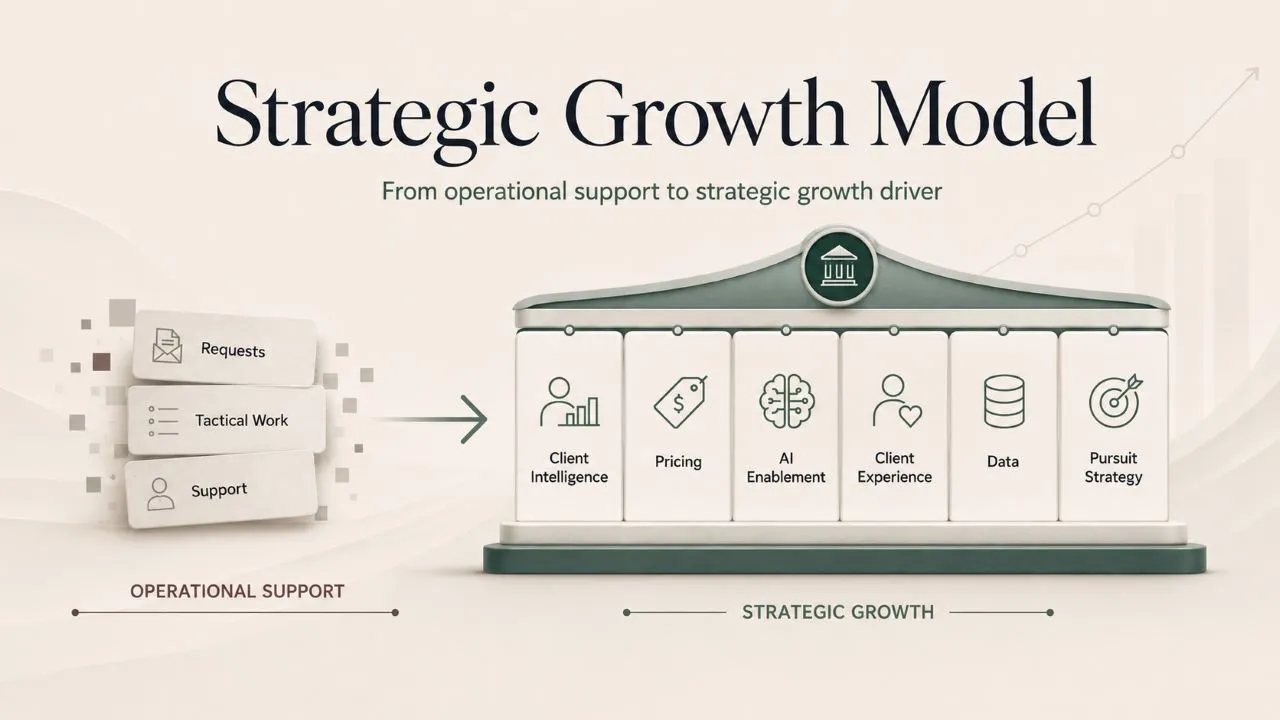
But future performance cannot depend on talented lawyers supported by a highly reactive service model. Firms need a more coordinated commercial platform, one that connects leadership priorities, client intelligence, industry focus, pursuit strategy, pricing, experience management, technology, and data. This is not simply a marketing issue. It is a firm strategy issue.
This shift is already underway. CMOs and business development leaders are no longer being asked to manage service-oriented departments. They are expected to advise firm leadership, strengthen client relationships, and help determine where the firm should place its bets.
Wendy Taylor made this point well in her recent American Lawyer piece on the collapse of the functional marketing team model. Her argument reflects what many firm leaders are already feeling: the old service model is under strain.
That distinction matters because firms cannot build strategic capacity if MBD departments remain organized primarily around requests and tasks. Capable teams may be working very hard, but effort alone does not create alignment.
AI Is Exposing the Weakness
There is a tendency to treat AI as a technology issue. In law firm marketing and business development, it has become an organizational design issue.
AI tools are well on their way to automating parts of the traditional workload: first-draft content, CRM cleanup, pitch assembly, meeting summaries, research support, directory submissions, experience summaries, and follow-up drafts. That does not make MBD teams less important. It changes the source of their value.
The most valuable MBD professionals will be those who can interpret market intelligence, spot opportunities, advise practice and industry leaders, improve the client experience, align technology investments with firm priorities, analyze trends, and connect data to decisions. In other words, AI will make responsiveness table stakes. The greater value will come from judgment, analysis, commercial understanding, and the ability to connect information to firm priorities.
Why Activity Is Not the Same as Alignment
When firm leaders feel frustrated with their current MBD structure, the problem is usually not inactivity. It is the opposite. Most MBD teams are extremely busy trying to keep pace with a market that has become far more demanding. The deeper issue is that activity does not always translate into impact.
Partners are facing a more complicated go-to-market environment than they did even a few years ago. Clients expect more context, more relevant experience, stronger industry understanding, sharper pricing conversations, and clearer value. The simple version of “help me market my practice” no longer matches what the market requires. That creates a mismatch.
Many partners still experience marketing and business development as a cost-center support function. At the same time, firm leadership expects those same teams to operate as strategic growth partners. CMOs are caught in the middle. They are expected to elevate the function, advise leadership, support partners, improve workflows, introduce AI, and drive coordinated growth, often within structures that were built for a reactive era.
This is why so many teams feel stretched. Rather than redesigning the function, firms often respond by layering new responsibilities onto existing structures—adding a role here, implementing a new technology there, hiring a specialist, modifying reporting lines, or creating another process to meet evolving partner expectations.
Eventually, the department is busy but not aligned. Work is hard to prioritize. Responsibilities overlap. Accountability gets blurry. Partners wonder what the department does. Strategic capacity gets crowded out by last-minute requests.
AI makes this more urgent because it will automate or accelerate much of the tactical work that has historically consumed MBD capacity. That creates an important opportunity, but only if firms use it to rethink the operating model rather than simply move the same requests through the system faster and call that success.
The good news is that firm governance is changing in ways that make transformation more possible. The traditional partner-consensus model has made significant operational change difficult. Today, strategic direction inside many Am Law firms is shaped by executive committees, COOs, CFOs, CMOs, pricing leaders, and other business executives working alongside firm leadership. Growing firms need smaller groups of operational leaders to drive decisions because the “all partners manage everything” approach is not scalable.
An important window is now open. Many firms have both the urgency to modernize and the leadership infrastructure to act.
Firms Pulling Ahead Are Thinking Differently
The firms making progress are investing in a strategic growth model: a framework that helps firms align leadership strategy, client development, operations, technology, data, and business development execution into a more coordinated platform. The model reflects a simple premise: modern law firm growth requires more than responsiveness. It requires structure, alignment, and operational discipline. The idea is not to modernize marketing for its own sake. It is to build a function capable of supporting how firms will compete in the future.
For managing partners and executive committees, this is about whether the firm is organized to compete. For COOs, it is about whether the operating model supports the firm’s priorities. For CMOs and business development leaders, it is about whether the department has the authority, talent, tools, and mandate to move beyond service delivery and help drive coordinated growth. That starts with a difficult but necessary assessment of whether the current structure supports the firm’s long-term ambitions or simply keeps a very busy team moving from request to request.