
Law firm marketing and business development teams are no longer starting from zero on AI. Most now have approved tools and policies in place. Many have team members who are experimenting with prompts, drafting support, summaries, research, and content development. Across my work with law firms, the question has shifted from “Who is experimenting with AI?” to “How do we make AI use more consistent, practical, and useful across the team?” That is the right question for MBD leaders now.
The challenge is not lack of curiosity. It is uneven adoption. Some team members are using AI productively and regularly. Others are testing it around the edges. Others are still unsure where it fits, how much they can trust it, or whether it is worth changing how they work.
That creates choppiness in confidence, quality, standards, and follow-through. For CMOs and business development leaders, this is where the next phase of AI enablement should begin. Foundational AI education is useful, but it should not be treated as the deliverable. The real value comes when teams connect that education to the recurring workflows they own every day, with clear standards for use, review, and judgment.
The better question is what changes after the training:
- Does proposal development become faster or more consistent?
- Do biography updates become more client-focused?
- Does competitive intelligence become easier to turn into action?
- Does event follow-up happen with more discipline?
- Do BD meeting notes turn into next steps instead of disappearing into someone’s inbox?
If the answer is no, then the team may have received AI education, but the work has not changed. That distinction matters.
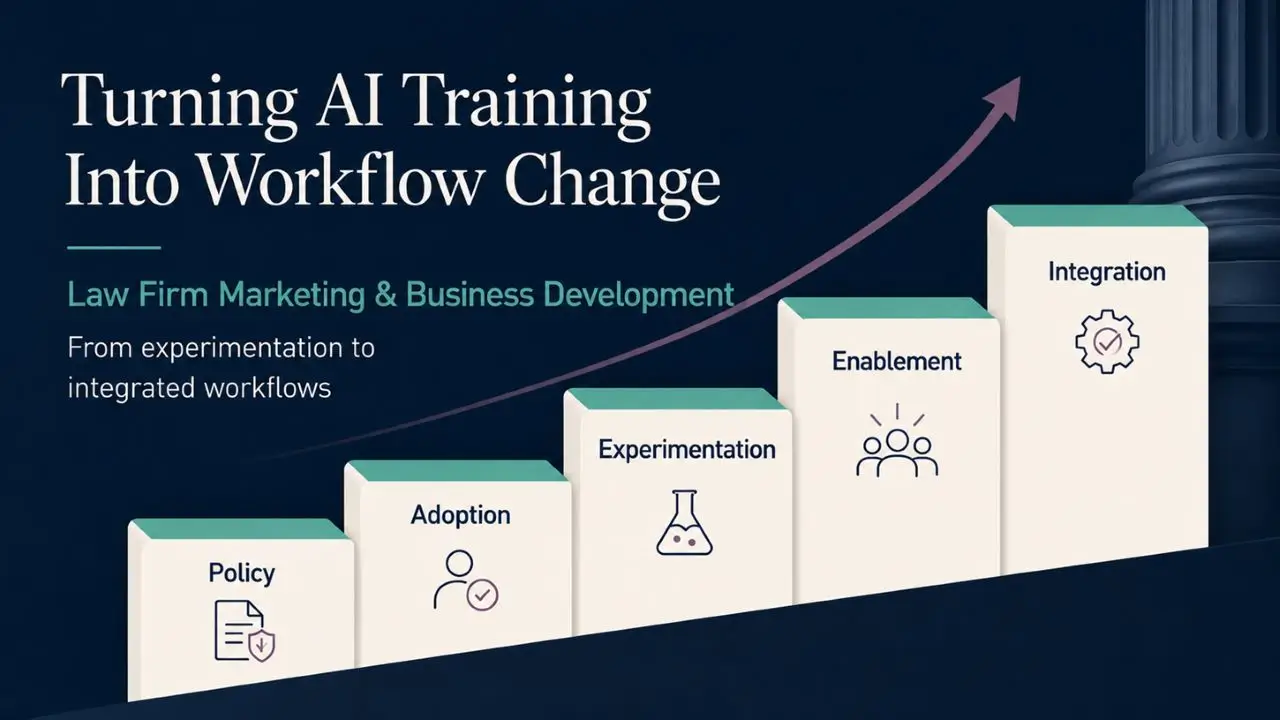
A useful way to think about AI maturity in MBD teams is through five stages: policy, adoption, experimentation, enablement, and integration.
In the policy stage, the rules exist, but regular use may not. In adoption, a few people are experimenting individually. In experimentation, use cases are being tested across functions. Enablement begins when the team starts building shared prompts, practices, and standards. Integration is when AI becomes part of daily operations.
Most law firm MBD teams I see are somewhere between adoption and experimentation. A smaller number are moving into enablement. Very few are truly at integration.
That is why the next investment should not automatically be another broad AI readiness program. In many firms, the better next step is to connect AI directly to recurring MBD workflows. This is where the rising tide can actually lift the whole team.
The opportunity is to look at the work MBD teams already own and ask where AI can reduce friction, improve consistency, and support better execution without creating unnecessary complexity.
The relevant workflows are familiar:
- Proposals and RFPs.
- Lawyer biographies and practice page updates.
- Rankings and awards submissions.
- Content repurposing.
- Competitive intelligence and briefing materials.
- Event follow-up.
- BD planning meeting follow-up.
- CRM reporting and activity summaries.
These are not abstract AI use cases. They are recurring MBD responsibilities where time is lost, quality varies, institutional knowledge is hard to capture, and follow-through depends too much on individual habits. Those are the places where AI can move from interesting to useful.
Take proposals and RFPs. In many firms, the team manually reads the RFP, identifies requirements, builds a compliance checklist, chases lawyers for input, searches for relevant experience, and drafts from prior language under deadline pressure.
AI will not replace the judgment required to position the firm or decide whether the opportunity is worth pursuing. But it can help summarize requirements, organize the RFP into a working checklist, identify missing information, generate lawyer follow-up questions, organize relevant content, and draft initial response language for human review. Or consider lawyer biographies and practice pages. Many firms struggle to keep